Research Program

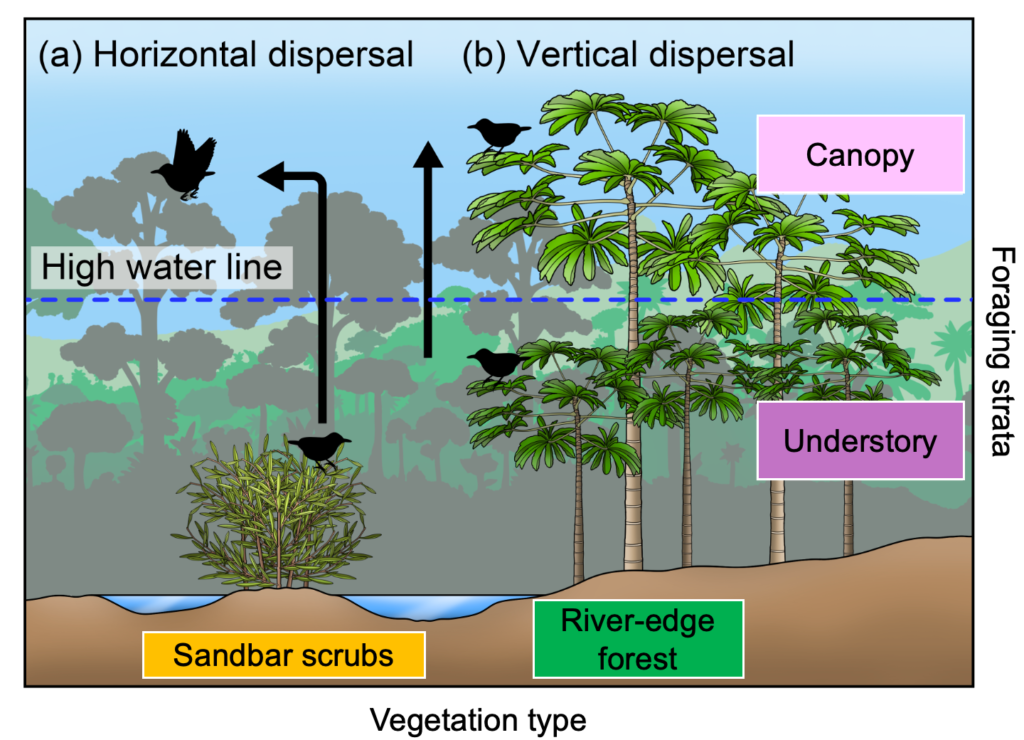
Conceptual model of habitat-driven dispersal in Amazonian floodplains. Artwork by Lucas Kías
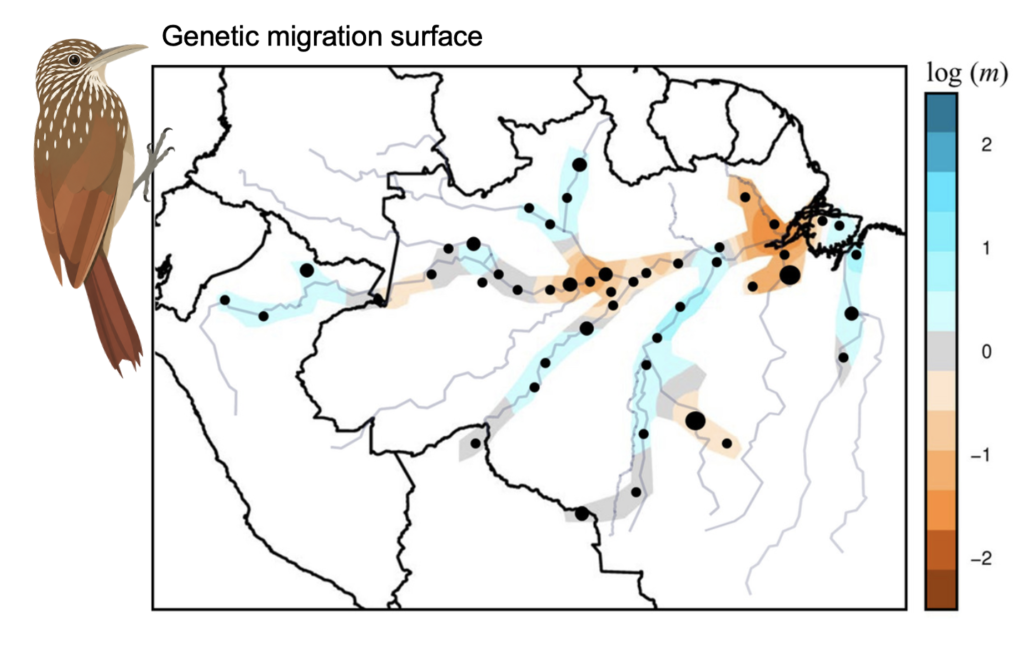
Gene flow across the distribution of the Striped Woodcreeper in the Amazonian floodplains. Blue indicates higher migration rates, while orange indicates lower migration rates and potential barriers to gene flow.
Geographical and Ecological Drivers of Evolution
How have ecological and historical processes shaped the present-day distribution of genetic diversity, populations, and species?
Changes in the landscape can shape evolution by separating populations and reducing opportunities for them to interact and exchange genes. However, species do not all respond to these changes in the same way. Traits such as dispersal capacity and habitat specialization may influence how strongly landscape changes affect gene flow and genetic differences among populations. To understand these interactions, we integrate population genetics and landscape ecology, combining genomic data with information on species distributions and ecology. Our goal is to understand how species’ ecological attributes and their environments interact to shape and maintain biodiversity.
For example, we study how bird communities in the Amazonian floodplains—the world’s most diverse wetland system—respond to changes in river landscapes over time, and how seasonal flooding shapes their evolutionary histories and demographic trajectories. Understanding these interactions between species and their environments not only helps us identify the major drivers of diversification and speciation but also helps us determine which species are likely to be more resilient or more vulnerable to ongoing and future environmental change.
Representative publications:
- Luna LW, Naka LN, Knowles LL, Sawakuchi AO, Aleixo A, Ribas CC (2023) Late Pleistocene landscape changes and habitat specialization as promoters of population genomic divergence in Amazonian floodplain birds. Molecular Ecology, 32(1), 214-228.
- Luna LW, Ribas CC & Aleixo A (2021) Genomic differentiation with gene flow in a widespread Amazonian floodplain-specialist bird species. Journal of Biogeography, 49(9), 1670-1682.
Genetic Consequences of Small and Declining Populations
How much do genetics contribute to population declines and extinction?
Rapid environmental changes, such as habitat loss and climate change, threaten the survival of many species. As populations become smaller, they can lose genetic diversity, become more inbred, and accumulate harmful mutations—a process known as genomic erosion. At the Luna Lab, we study how population decline and life at small population sizes shape the genomic architecture of species, and how these genomic changes influence their ability to survive and adapt. We use long-term ecological studies and museum specimens to compare genomes from the past and present, allowing us to track genetic changes through time and connect them to events such as habitat fragmentation and periods of intense overexploitation.
We study species with small and restricted populations, such as the critically endangered Araripe manakin (Chiroxiphia bokermanni) in Brazil, as well as widespread species that have declined rapidly, such as the ruffed grouse (Bonasa umbellus) in North America. By comparing species with different population histories, our research program aims to understand how population decline and evolution in small populations reshape diversity and the distribution of functional variation across the genome. Ultimately, we seek to develop a unified framework determining to what extent changes in genomic composition contribute to species resilience or extinction, elevating genomic erosion from a descriptive metric to a predictive tool for understanding evolutionary resilience and guiding biodiversity conservation.
Representative publications:
- Luna LW, Silva SM, Silva WAG, Gaiotti MG, Macedo RH, Araripe J & Rêgo PS (2022) Genetic monitoring of the Critically Endangered Araripe Manakin reveals low diversity and effective population size decline. Ornithological Applications, 124(2), duac009.
- Luna LW, Williams LM, Duren K, Tyl R, Toews DPL, Avery JD (2023) Whole genome assessment of a declining game bird reveals cryptic genetic structure and insights for population management. Molecular Ecology, 32(20), 5498-5513.

The Critically Endangered Araripe manakin (Chiroxiphia bokermanni). Photo by Ciro Albano
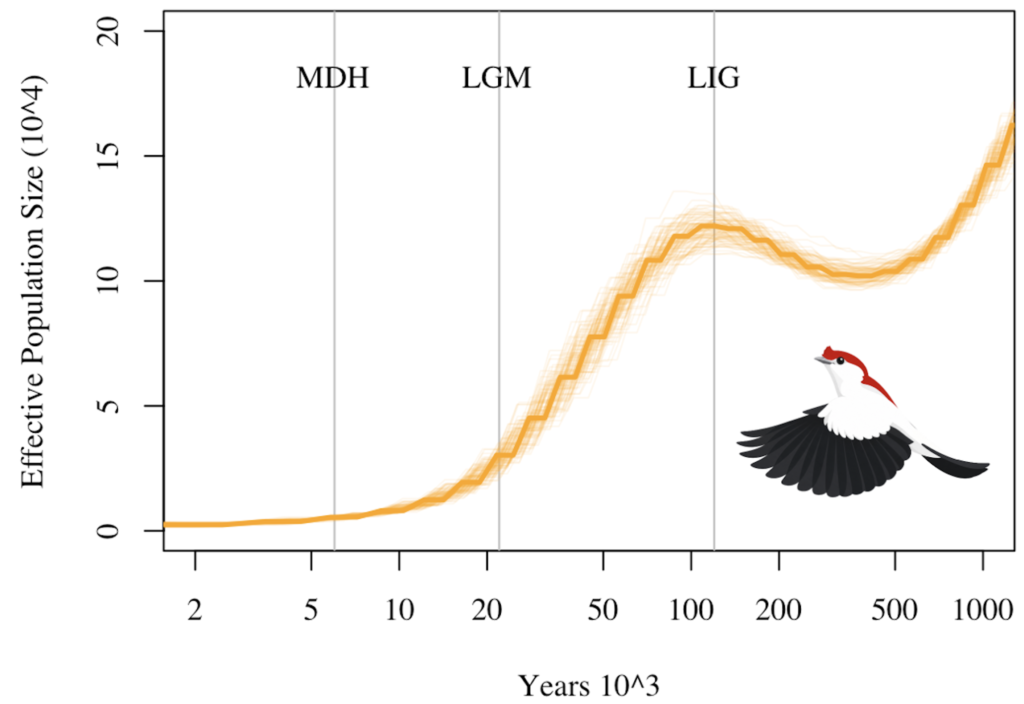
Demographic history of the Araripe manakin showing a decline in effective population size over time.